Saturday, April 13, 2013

Bisbee, Arizona Evergreen Cemetery April 1, 2013

                                        Memorial to a Veteran of the forgotten Korean War

Location: Evergreen cemetery is located in Lowell, Arizona, (a couple of miles from old Bisbee), off of Douglas Road. The small town became seperated from Bisbee when miners excavated the Lavender Pit. The cemetery is located across from the high school. It is a big cemetery and easy to find when you turn onto Douglas Road.

Wondering among the graves I was surprised at what I found. Bisbee had many immigrants from England and Wales as well as Eastern Europe who came to work in the copper mines. I did not find many of these gravesites. I did find dozens of war veteran graves. I found graves of veterans from the Spanish American War, Civil War, World War I, World War II, Vietnam War and Korean War.  I always enjoy visiting cemeteries because they augment local and national history. Included in this post are some of my favorite pictures from the visit.


                             Veteran of the Vietnam War

                          Veteran of the Civil War


                              Memorial to those who died off Guadalcanal in 1942

                                 Immigrant from Ireland. As noted above immigrants were instrumental in working mines throughout the west

                           Grave for Clarence Warner

                     Memorial to James H. Brew who was shot in his home in Bisbee, Arizona, after he shot one of four guys who came to force him back to work during the labor unrest of 1917.

                               Immigrant of Aberdeen, Scotland

                                     Veteran of the Spanish American war

                               Headstone written in a Slavic language

Saturday, March 23, 2013

Memorial to the completion of the Transcontinental Telephone Line Wendover, Utah

                                     The original telephone poll on the border

For a small town West Wendover and Wendover, Utah, have a significant amount of history. On this blog I have posts on the Wendover Airbase, California Trail and Pony Express. (The Pony Express didn't come through town but 50 miles to south). This post is dedicated to an overlooked memorial near the Montego Casino commemorating the completion of the first Transcontinental Telephone Line in 1914.

                                Plaque giving history on the event

Tuesday, March 19, 2013

Leppy Peak Hike Eastern Nevada March 16, 2013


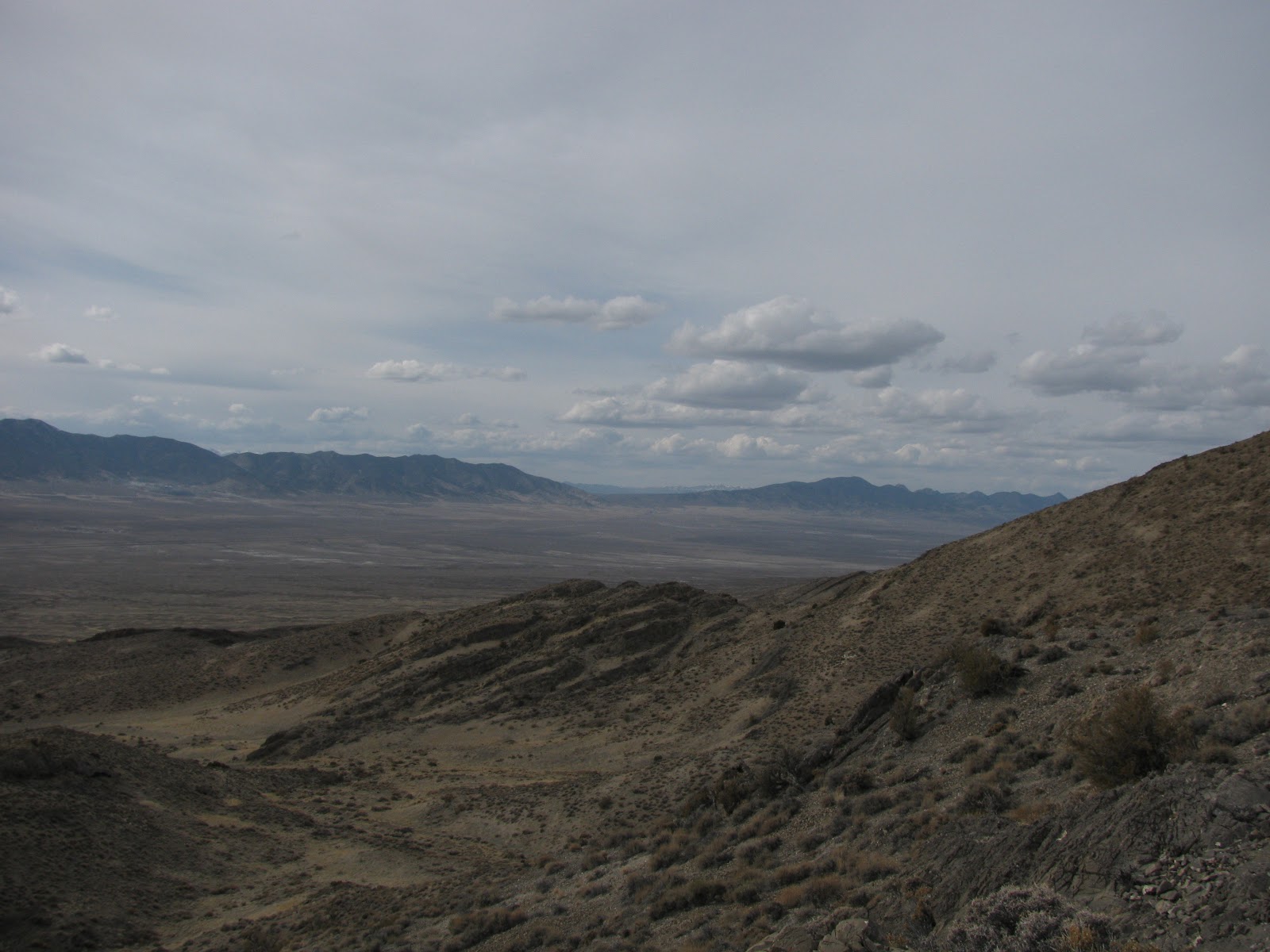
Location and hike: The Leppy Hills are located to the north of West Wendover. This range is overlooked because it has sparse vegetation and travelers want to hike other more picturesque ranges. However, on my various hikes I have seen great views, caves, interesting rock formations and Bighorn Sheep. A hiker has to be willing to hike off-trail or on ATV trails not on traditional hiking trails.  Today I am hiking on the highest peak: Leppy Peak at almost 3,000 feet. It is impossible for me to describe the route because it is entirely off-trail.  Be careful when hiking off-trail and remember to use common sense. Today I was rewarded with watching eleven Desert Bighorn Sheep for over an hour. Enjoy some of my favorite pictures from the hike. It was amazing how nimble the sheep were on extremely rocky and steep terrain.


                                  Looking south from on the ridge of Leppy Peak

                         Looking north toward Silverzone Pass

Friday, March 8, 2013

Silverzone Pass on the Union Pacific Eastern Nevada March 2013

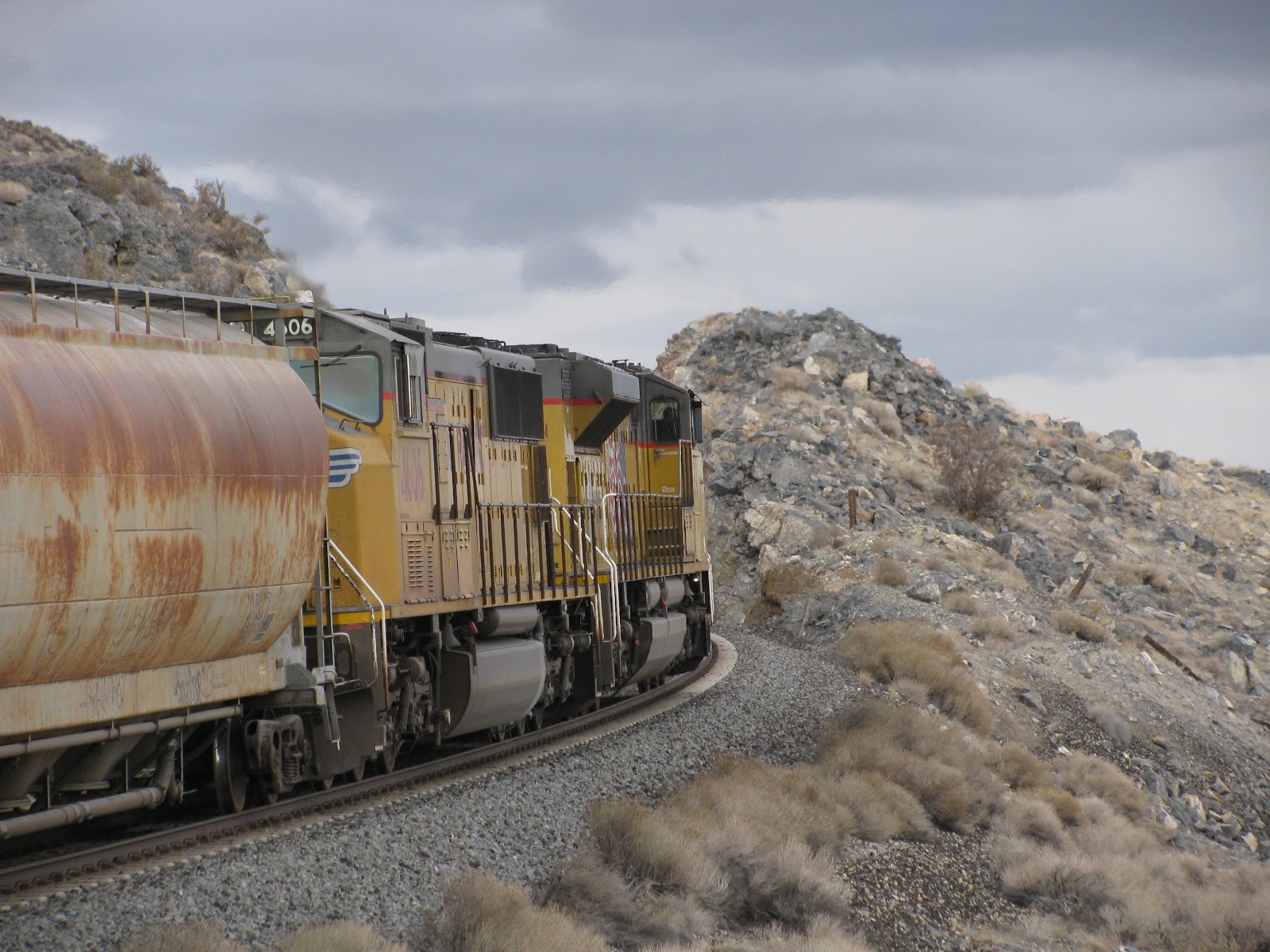
                  A westbound Union Pacific grain train enters a rock cut on Silverzone Pass

On two seperate trips I explored various parts of Arnold's Loop on the Union Pacific to photograph trains climbing over the Toano Mountains in Eastern Nevada. The railroad gains elevation quickly by looping over itself. At my favorite spot an observor can see trains on two different levels. Most of the photos on this post come from my second trip when I chased three westbounds from West Wendover on Interstate 80. I love this area because you see trains, great scenery and wildlife. Remember to stay away from trains and carry provisions such as water. On this blog I have included my favorite pictures of the trains as well as a herd of deer.

                                Herd of mule deer

Another pic of deer
                                 Train on upper part of pass. It has already gone around the loop.

                                  UP grain train near siding at lower part of pass 

           Westbound climbing grade; if you look closely you can see the tracks on the upper side of        the hill to the right.

                               Same westbound at end of siding on lower part of loop

                            Chugging toward the rock outcrop

                          Lower tracks with train on upper part of hill after it has gone around loop

Sunday, February 24, 2013

Northern part of Toano Mountains of Nevada Exploration February 17, 2013

                        Looking west toward the Pequop Mountains

Location: The area I am exploring is the northern part of the Toano Mountains north of the Shafter exit on Interstate 80 in eastern Nevada.

Nevada and I spent about three hours hiking along a ATV track because it was easier walking. In the pinyon pine and sagebrush there was 10 plus inches of snow on the ground making harder walking. During our hike we met two coyote hunters out for the day who were talkative.  Later on this spring I am going to climb the mountain in photograph number three. It appeared there was a relatively easy way to the top. Enjoy my photographs and remember Nevada is a beautiful state.

                                       Nevada in the snow

                      The mountain I want to climb later in the spring. You can see the band of green to the top

                          Nevada in eastern Nevada

                     Looking west toward the Pequop Mountains and Shafter Valley.

Friday, February 22, 2013

Atomic Testing Museum Las Vegas, Nevada February 9. 2013


                                      Timeline highlighting important events in the 50s

Location: The Atomic Testing Museum is located on East Flamingo Road at the Desert Research Institute (DRI). To get to the DRI turn off of Las Vegas Blvd near Tropicana Casino.

General Information: Admission is $14 for the museum and $6 more for the special Area 51 Exhibit. Military and Nevada residents get in for $11.This museum has alot of great information. To see everything I would allocate at least 2-3 hours at the location.

 Exhibits chronicle the develoment  and testing of the Atomic bomb in the United States and throughout the world. In the first part of the museum displays give information about the Cold War and the need to respond to the nuclear threat presented by the USSR. It continues with the development and detonation of the Atomic bomb in New Mexico code named Trinity. After the Trinity Test, the United States Government tested bombs in the Pacific at Bikini Atoll. The rest of the museum gives information on the development of the Nevada Test Site and the approximately 900 above and below ground tests conducted primarily at Yucca Flat and Frenchman Flat. The Area 51 special exhibit has some good information but I do not think it is worth the $6 admission. Museum curators spent way too much information on the UFO conspiracy in New Mexico as well as Groom Lake. (Some information from the Atomic Testing Website). In a later post I will give a comprehensive history of the Nevada Test Site.

                              Craters from underground test at Yucca Flat

                      Diagram showing an underground test in a mine at the Nevada Test Site

                     America's largest underground test was not in Nevada but in Alaska 

                                  Map showing nuclear detonations at the Nevada Test Site

                       Information on the different levels of nuclear waste; Yucca Flat has become a respository for low level waste

                                  Badge used at the Nevada Test Site

                                              Geiger instruments used to monitor radiation 

             An istrument used to take pictures and record scientfic information during an underground   detonation

Organized Crime and Mob Museum Las Vegas, Nevada February 9, 2013

                                 Information panel talking about the end of Prohibition

Location: The Organized Crime and Mob Museum is located at 300 Stewart Avenue in downtown Las Vegas at the old Court House. If driving from The Strip; take Las Vegas Blvd until you reach Stewart Avenue. This can be a long drive in traffic so stay patient. Turn left onto Stewart Avenue and the museum will be on the right. Parking is available next door for a fee however, free parking is available at the Farmer's Market lot.

General Information: Admission is $19.95 for the General Public, $15.95 for Seniors and Military and $10 for Nevada residents. This museum is very informative and I highly recommend allocating a significant amount of time to visiting it. Exhibits tell the story of the mob from its inception around Prohibition to present day. Visitors learn about such mobsters as Lucky Luciano, Al Capone, Bugsy Siegel, Whitey Bulger and many more. Exhibits also tell how law enforcement evolved their techniques to catch and prosecute mobsters through the use of undercover officers and informants. Finally, a large section is devoted to organized crime in Las Vegas, Nevada.  (Some information from the Mob Museum website).

                                                    John Roselli information plaque

                        Alcohol Testing Kit and Evidence bottles from Prohibition era America

                                          Prohibition era liquor bottles

                                              A thematic map of early Las Vegas

                       Actual wall from the Valentine's Day Massacre which indirectly led to Capone's downfall

                                A "Tommy Gun." Popular weapon used by hitmen.

                               Performers at the Cotton Club

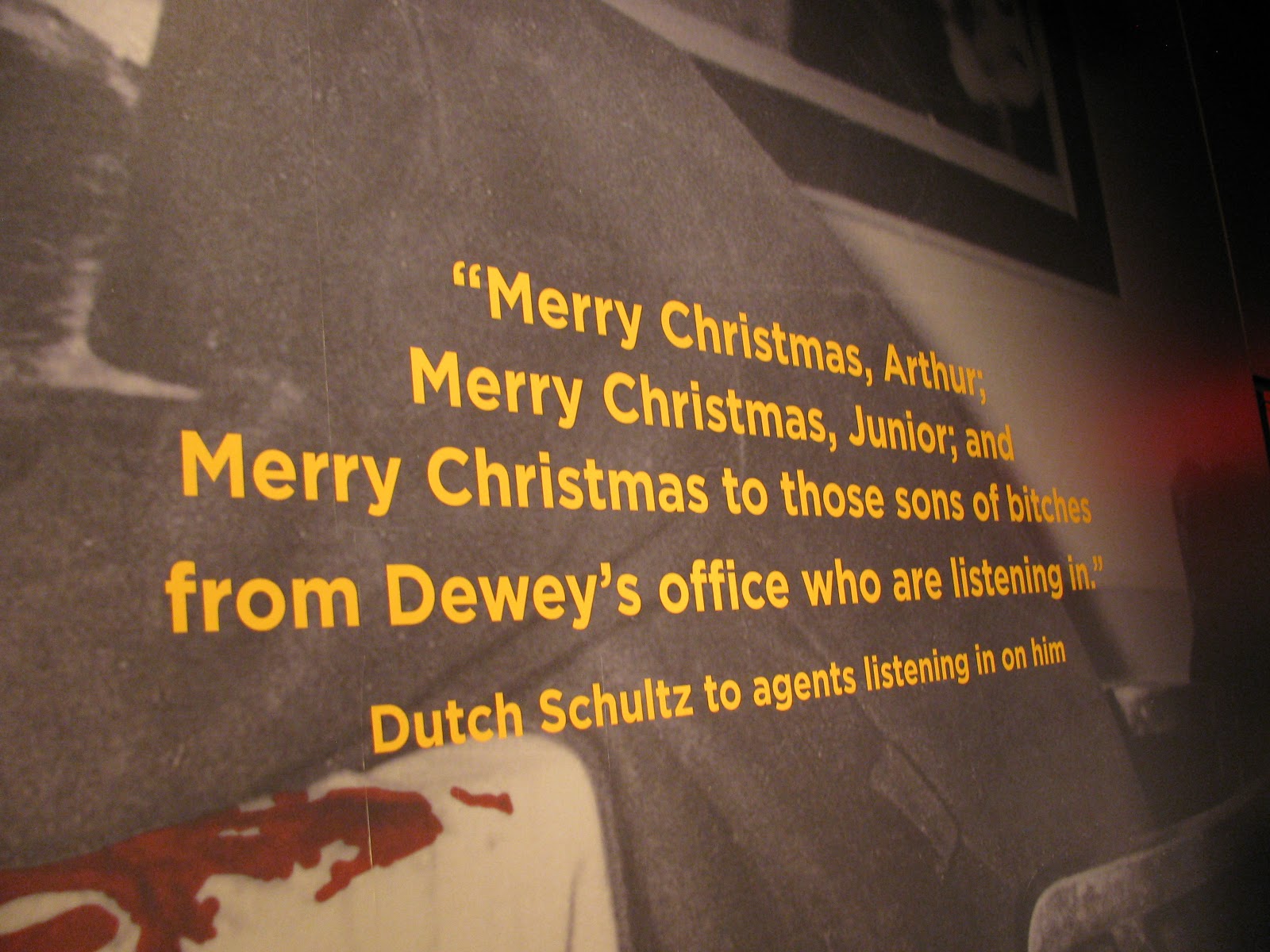
                                Interesting quote

                               Exhibit on early Vegas

                                   Handgun used by police forces 


Quintin and I at the museum